Physical infrastructure and water claims are not the same thing.
A rain garden can be installed and verified as a physical asset. A cistern can have known dimensions and a documented contributing roof. A project can be functioning without automatically supporting every type of replenishment, volumetric-benefit, or disclosure claim.
Shoalwater separates what is observed, what is modeled, and what can responsibly be claimed.
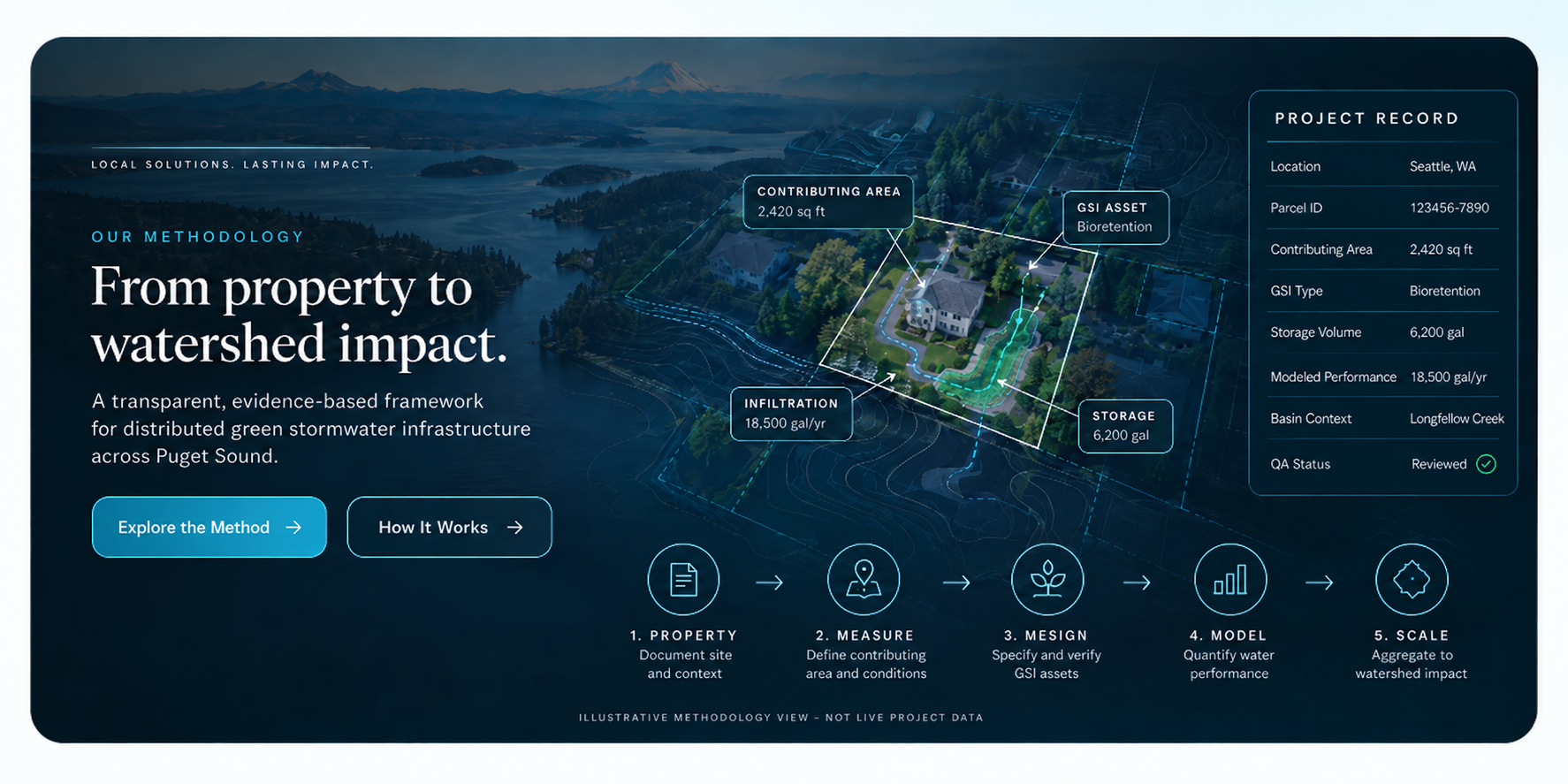
Five layers from field evidence to watershed context.
Project Identity
Record the property, project location, installation type, ownership context, project status, and relevant basin.
Physical Inputs
Record contributing impervious area, storage, treatment area, system dimensions, and other measurable project characteristics.
Project Record
Preserve installation evidence, post-inspection records, photographs, contractor documentation, and other supporting files.
Water Performance
Translate physical project inputs and rainfall assumptions into clearly defined modeled water-performance metrics.
Basin Context
Connect individual projects to watershed, drainage, and portfolio context without obscuring property-level evidence.
A persistent record for each project.
- Property location
- Ownership or host context
- Watershed / basin attribution
- Project access and consent status
- GSI project type
- Installation date
- System dimensions
- Storage or treatment characteristics
- Contributing impervious area
- Roof or drainage area
- Rainfall assumptions
- Modeled annual water performance
- Post-inspection records
- Installation photographs
- Contractor / project documents
- Maintenance and condition records
Not all managed water is the same.
Captured
Water physically intercepted by the system before discharge.
Detained
Water temporarily stored and released more slowly to reduce peak flow.
Infiltrated
Water routed into soil where site and system conditions support infiltration.
Reused
Captured water used for an appropriate non-potable application such as irrigation.
Treated
Runoff passed through a system designed to improve water quality.
Peak Reduced
A modeled reduction in discharge intensity or timing during storm events.
Transparent assumptions over black-box numbers.
Shoalwater uses project-specific physical inputs and clearly stated rainfall assumptions to estimate water performance. Where calculations depend on infiltration, drawdown, storage behavior, or other site-specific conditions, those assumptions are identified explicitly.
Roof area, system dimensions, contributing area, storage, and project type.
Rainfall, drawdown behavior, infiltration, reuse, or other modeled conditions.
Each metric is labeled by what it actually represents.
Project calculations remain linked to the underlying physical record.
Consistency matters as the project network grows.
Source Records
Preserve original project documentation and distinguish source evidence from derived values.
Standard Units
Normalize contributing area, storage, rainfall, and water volumes into consistent units.
QA Status
Track whether records are complete, incomplete, pending review, or suitable for aggregation.
Consent & Attribution
Preserve property-owner permissions and clarify how project data may be used in aggregated reporting.
Project Status
Distinguish candidate, planned, installed, active, restored, and inactive infrastructure.
Version Control
Maintain clear methodology versions as assumptions, standards, and project requirements evolve.
A project record does not automatically equal a replenishment claim.
Corporate water stewardship, volumetric water benefits, replenishment accounting, and public disclosure can require additional methodology, baseline, additionality, duration, stakeholder, and assurance considerations.
Shoalwater does not treat every GSI project as interchangeable or automatically eligible for every water claim.
Shoalwater documents and develops projects. It does not replace licensed technical practice.
Where a project requires civil engineering, geotechnical review, hydraulic modeling, permitting, structural analysis, plumbing design, regulatory certification, or specialist technical judgment, Shoalwater works with appropriately qualified professionals.
The methodology is designed to strengthen project traceability, not blur professional responsibility.
Built to remain compatible with established water-stewardship practice.
Reference to a framework does not imply certification, endorsement, or automatic conformity. Applicability depends on project type, program requirements, and the specific claim being made.
Better infrastructure starts with better project evidence.
Shoalwater is building a consistent documentation layer for distributed green infrastructure across Puget Sound.
Discuss a Project ↗